Many decorating mistakes are not apparent until much later after they are finished. At that point the room may feel too overly decorated or become annoying to maintain. Or you may find you need to pay again to fix what you originally bought. This is where the real cost of a trend that will only last a short time stems from. You are paying for the look but also paying for the installation, ongoing maintenance, creating visual fatigue and possibly needing to undo the look completely.
If you want a home that feels current without becoming a project, the goal is not to avoid personality. It is to put personality in the places that are easiest to change.
TL;DR
- The trends that age worst are usually the ones tied to fixed surfaces, weak function, or expensive reversal costs.
- Use the F.A.D.E. Test before buying: Flexibility, Appeal beyond the moment, Durability, and Exit cost.
- Safer long-term choices often include warm neutral paint, simple doors, closed storage, quieter hard finishes, and one or two portable statement pieces.
- If you may move within five years, keep trend spending mostly in art, textiles, lamps, and smaller furniture rather than tile, flooring, cabinetry, or specialty millwork.
- When a room feels bland, fix scale, lighting, and storage before adding another dramatic trend.
Why some decorating trends turn into expensive regrets
Most short-lived fads have common issues. They are very tied to an exact time frame, they lower the practicality of a space on a daily basis, or they are now a large investment consideration (due to needing expensive materials to add). For example, a fun accent pillow is a nice way to enhance your décor with a trend. A fun accent tile for a backsplash, custom wall treatment, or a specialty door would be a different issue. Once you put a trend on drywall, tile, cabinets, and/or wiring, it is no longer just a décor style choice; it has become part of a mini renovation project.
That lines up with how housing professionals think about value. NAR’s consumer staging guide says the point of staging is a clean, neutral backdrop that helps buyers picture themselves in the home. NAR’s 2025 Remodeling Impact Report also says REALTORS® most often recommend painting the entire home or painting one interior room before listing, and JLC’s 2025 Cost vs. Value report says exterior upgrades usually outperform discretionary interior remodels on resale because highly specific finish choices are not universally appealing. (nar.realtor)
Use the F.A.D.E. Test before you buy
Before you commit to a trend, score it on four questions. This is one of the fastest ways to separate a smart refresh from a future tear-out.
- Flexibility: Will it still work if you change the sofa, rug, paint, or even the next owner’s style?
- Appeal beyond the moment: Does it read as a good room, or does it immediately signal one specific trend era?
- Durability: Can it handle real life, including fingerprints, dust, grease, pets, moisture, or kids?
- Exit cost: If you hate it in three years, what will removal, patching, repainting, rewiring, or replacement cost?
- Guidelines for making decisions about the safety of surfaces: Score between 16 – 20, most often considered safe for fixed surfaces. Score between 11 – 15, are acceptable when used on semi-permanent surfaces. Score of 10 or less, should typically be used only as decorative accents.

The trends most likely to age badly, and the smarter move instead
| Trend | Why it ages fast | What to do instead | Budget-minded note |
|---|---|---|---|
| Gray-everything rooms | Too one-note and chilly when walls, floors, and upholstery all lean gray | Use a warmer base palette, then add contrast through art, textiles, and lighting | Paint is cheap to revise; flooring and large sofas are not |
| Barn doors and full-theme farmhouse | Strong association with one era and weaker privacy or sound control | Choose simple doors and add warmth with wood, woven texture, or antique brass | Keep the theme in movable pieces, not architecture |
| Open shelving replacing storage | Looks good only when highly maintained and cuts usable storage | Keep most storage closed and reserve one shelf for display | Closed storage can save money on future cabinet fixes and clutter-control buys |
| Busy permanent surfaces | Graphic tile, slat walls, and faux-luxury films dominate the room and are expensive to undo | Use quieter hard finishes and put pattern in paint, wallpaper, runners, or art | The bolder the fixed surface, the higher the future reset cost |
| Oversized trend furniture or matching suites | Hard to rehome, easy to date, and often wrong for the next room | Buy one classic anchor piece and let smaller items carry the trend | Portable style usually beats replacing a full room set |
1. Gray-everything interiors
A gray room can be very nice if it’s one component among many. Why? While all at once the monotonic all-gray interior looked stunningly current and sophisticated, many spaces that were designed in this manner have turned out cold, lifeless (due to lack of light) and very unwelcoming. This all-to-obvious example points out the real problem with using gray in the interior is that it can easily become a flat note (rather than one note to create harmony) with no possibility for contrast & creativity from all the shades of gray that have been used throughout today’s design world. Instead of using gray as the only colour in today’s designs use one of the other tones to create the main foundation or colour palette and then use gray(s) to add additional colour to your design.
Zillow’s paint-color research found that room colors can be associated with meaningful sale-price differences, which is a good reminder that fixed paint choices are not throwaway decisions. (zillow.com)
2. Barn doors and hyper-themed farmhouse details
The heavy false rustic wood doors along with the slogan signs & vintage black pipe door/rail hardware, and the distressed finishes indicate a certain time period in home decor styles. In some homes, the style might still exist if the other elements are in the same home, but it would tend to be dated as a style, since it is more suited to a costume, than a backdrop. A good example is barn doors. They are unique in appearance, but they do not provide as much privacy or sound control, nor do they work well with the overall aspect of wall clearance in most homes.
In order to create warmth in an environment, simplicity in design should be used to help maintain traditional methods of warmth with the addition of decorative elements such as a wooden bench, woven window coverings, an old piece of mirrored glass, or even a single unique antique item that does not restrict your overall design to one style.
3. Open shelving everywhere
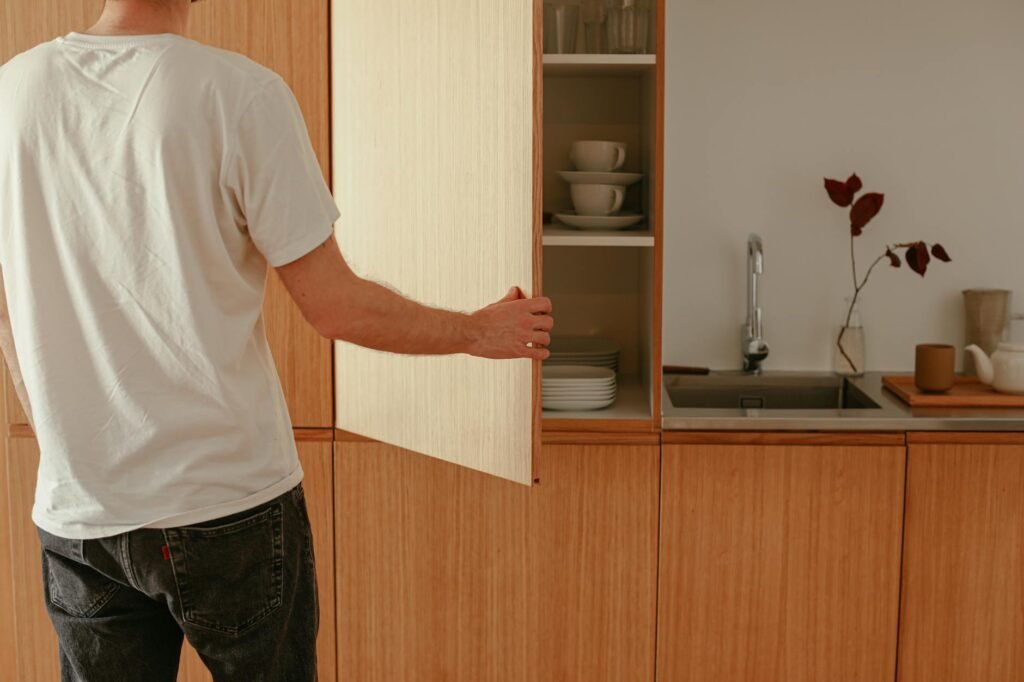
Open shelving is an example of a design concept that works better in photos than in real life. In actual homes, plates do not always match in color, bath products are seldom attractive, and dust does not have days off. Additionally, the financial aspect of replacing useful cabinets with display shelves creates an additional future expense of needing more hidden storage.
A better rule is 80/20: keep at least 80 percent of kitchen and bath storage behind doors, and use one shelf or niche for the pretty things. NAR’s staging guide even recommends closets be half full rather than crammed, which tells you a lot about how much visual breathing room matters. (nar.realtor)
4. Loud permanent surfaces
High-contrast geometric backsplashes, busy cement-look tile, wall slats in each room, checkerboards in excess, kitchen cabinets with faux marble films, and ultra trendy special lighting can all have a short life span because of one thing: they do not blend into the background but instead take over the room as its identity. This can be there to help you at first but end up exhausting you soon enough.
The smarter option is to use subject matter that has hard finishes to create a more discreet and flexible atmosphere. If you’re looking for an eye-catching décor statement, you can achieve this by painting your walls, using small wallpapers, adding a vibrant rug, featuring an interesting lamp, or using large artwork on walls. All of these items will give your home uniqueness but can be easily removed when you choose to change them from your home.
5. Oversized trend furniture and matching room sets
When the shape, texture, and size of a piece of furniture are all too much for one another, it results in an outdated trend in furniture. For example, consider large matching suites, too-low, too-deep sofas that take up way too much space, and white, sculptural pieces that you’re only buying because they look good on the internet. These are usually expensive, bulky, and not practical for your new home.
The best approach is a single piece of furniture that offers a stable anchor but allows you to change the mood of your room through layering. For example, use small items like a chair, side tables, decorative pillows or throws, table lamps or art – and you can change up the feel of your space without needing to replace everything in the room. This way, you can change the look of your space over time without needing to redecorate your whole room.
A realistic $4,000 room refresh: risky version vs. durable version
Picture a household with $4,000 to refresh a living room and a possible move in four years. The risky version looks current on paper: $900 for a slat accent wall, $700 for a barn door to the office, $1,200 for two trend-heavy chairs, $450 for an oversized black fixture, and $350 for theme decor. Total: $3,600.
But if the room feels dated before the move, the likely second-round costs start piling up: maybe $450 to patch and repaint the wall, $300 to reinstall a conventional door, and several hundred dollars if the chairs wear poorly or do not fit the next place.
The durable version uses roughly the same budget differently: $650 for warm paint across connected spaces, $1,600 for a classic sofa, $700 for a good rug, $450 for a closed-storage console, $250 for lighting upgrades, and $250 for art and textiles. Total: $3,900. The second room may be less flashy on social media, but much more of the spending can move with you.
Not every personal choice is a bad investment. High-quality custom work that improves function is different from a cheap trend package. Zillow’s 2026 analysis found that listings mentioning custom features and turnkey condition were associated with higher prices, while fixer-uppers were associated with steep discounts. The practical lesson is not “never personalize.” It is “make sure the room feels finished, useful, and easy to live with.” (zillow.com)
How to reset a dated room without starting over
- Remove about 30 percent of the visible decor first, especially repeated theme items, word art, faux distressing, and small clutter.
- Repaint the biggest sightline before buying more accessories. In many rooms, paint changes the mood more than new decor.
- Put everyday mess behind doors, drawers, baskets, or cabinets. Hidden storage makes almost any style look more expensive.
- Limit each room to one clear trend signal, not four. If the room already has a bold light fixture, skip the slat wall and the graphic rug.
- Add warmth through materials that age well: wood, linen, stone, leather, wool-blend textiles, and softer lamp light.
- Photograph the room in daylight and at night before making the next purchase. Rooms that only work from one angle usually are not actually working.
Common mistakes that make a room feel dated even faster
- Buying a whole look at once instead of building around one strong anchor piece.
- Putting the boldest idea on the most expensive surface in the room.
- Confusing gray with neutral and white with timeless.
- Ignoring cleaning burden, especially in kitchens, bathrooms, and entry areas.
- Choosing furniture for the photo rather than the room’s actual size and traffic flow.
- Skipping samples under both daylight and evening light before painting or installing finishes.
When the safe plan feels too bland
There are times when you start out making an effort to create “timeless” but go way overboard and in return take away the energy in your space. When that happens make sure you are not quick to assume that the permanent element needs to be more dramatic than it currently is. The majority of issues are related to either proportion/lack of contrast/lack of proper lighting. For instance, adding a larger piece of artwork, fuller drapes, darker lamp bases, a vintage wood table, and/or different patterned rugs can greatly increase the amount of ‘life’ that your space has rather than simply adding another statement wall.
Renters should lean even harder in that direction: curtains, bedding, lamps, art, and removable paper are much safer places to experiment than anything that triggers patch fees or replacement costs later.
And if your choice is between another decorative flourish and a comfort or maintenance upgrade, give the less glamorous project a fair hearing. NAR’s 2022 Remodeling Impact Report found strong cost recovery for hardwood refinishing, new wood flooring, and insulation upgrades, and DOE notes that insulation and air sealing can reduce heating and cooling costs while improving comfort. In budget terms, that often beats paying for a trend-driven finish you may later remove. (nar.realtor)
This article is informational. Before major built-ins or door, tile, electrical, or millwork changes, confirm measurements, permit or HOA requirements, and local resale expectations with the appropriate professional.
How to verify your choices before you spend more money
- Create an undo budget. Write down what it would cost to remove, patch, repaint, rehang, or replace the trend if you hate it in three years.
- Do the grayscale test. If the room only works because one trendy finish is screaming for attention, that usually shows up immediately in a black-and-white photo.
- Wait 30 days on any fixed-surface trend purchase. If you still want it after a month, it is more likely to be taste than impulse.
- Ask one practical person, not just one style-loving friend. If you may sell within five years, get feedback from a local real estate agent or designer too.
- Name the function. If you cannot explain how the purchase improves storage, comfort, light, durability, or layout, it probably belongs in a smaller, cheaper version.
Bottom line
It’s not just the daring decorating trends that have the shortest shelf life but also the trends that are expensive to undo, difficult to maintain, or that lock your space into one particular era. When designing your home, choose to create lasting choices that are easy to use for storing things, as well as one or two pieces of movable decor. While these decisions may feel less than exciting over the course of a weekend, they are typically going to provide you with a better experience and a greater potential for your home’s appearance in the future.
FAQ
How long should a decorating trend stay appealing before I use it on a fixed surface?
When selecting items that will last from 5-7 years for your home including but not limited to tile, flooring, millwork, cabinetry, specialty doors, or rewiring, there is a practical guideline. For shorter item lifetime cycles (lamps/pillows/art/paint in small rooms/occasional furniture), there is no need to wait before investing in these types of home goods or services.
Is gray paint always a bad choice now?
Absolutely! One warm gray works well in bright homes but an all grey formula of walls, floors, upholstery, and metals will create the same cold colors together with little warm/cool contrast.
Are barn doors ever worth keeping?
Sometimes. They can be useful where privacy and sound control are not important, such as a pantry or laundry area, and only if the wall is deep enough. For bedrooms, baths, and most home offices, a conventional hinged or pocket door would work better.
What is the safest way to add personality if I may sell in a few years?
Put personality in layers that are easy to swap: art, rugs, pillows, throws, lamps, smaller wallpaper zones, side chairs, and paint that is easy to cover. Keep cabinetry, tile, flooring, and major lighting flexible.
How much of a room budget should go to trend items?
It is reasonable to keep trend-heavy purchases at about 10% to 15% of the overall room budget as long as you plan to move within the next 5 years. If you expect to stay longer than that and the item scores favorably according to the F.A.D.E. Test, you could spend more than this upon purchase.
Should I replace trendy tile or other dated finishes before listing my home?
There is no automatic guarantee that the area will be neutralized; there must be a manual process to do this by cleaning, improving the lighting in the room, decluttering the area and staging the area for maximum effect on buyers. Only if new finishes or renovated finishes negatively affect the appearance of the home in the listing will we replace them.
References
- NAR Consumer Guide: Staging Your House for a Sale – https://www.nar.realtor/the-facts/consumer-guide-staging-your-house-for-a-sale
- NAR 2025 Remodeling Impact Report – https://www.nar.realtor/sites/default/files/2025-04/2025-remodeling-impact-report_04-09-2025.pdf
- NAR 2022 Remodeling Impact Report – https://www.nar.realtor/sites/default/files/documents/2022-remodeling-impact-report-04-19-2022.pdf?mf_ct_campaign=msn-feed
- JLC 2025 Cost vs. Value Report: Key Trends – https://www.jlconline.com/cost-vs-value/2025-cost-vs-value-report-key-trends
- Zillow Research: Paint Colors Help Your House Sell for More – https://www.zillow.com/research/paint-colors-help-sell-20240/
- Zillow Research: 2026 Home Features That Sell for More – https://www.zillow.com/research/home-features-that-sell-2026-36190/
- Department of Energy: Insulation and Air-Sealing Essentials – https://www.energy.gov/cmei/buildings/articles/energy-efficient-home-improvement-credit-insulation-and-air-sealing